





Product Details
- Product Number
- 250654
- Series
- GIP-119
- Scale
- NO SCALE
- Alternate ID
- GIP-119
- ISBN
- 978-1-4113-3048-1
- Authors
- JILL MCCARTHY
- Version Date
- 04/01/2011
- Regions
- TN, MS, MO, KY, IN, IL, AR
- Countries
- USA
- Media
- Paper
- Format
- Bound
Additional Details
- Description
-
This handbook provides information to residents of the Central United States about the threat of earthquakes in that area, particularly along the New Madrid seismic zone, and explains how to prepare for, survive, and recover from such events. It explains the need for concern about earthquakes for those residents and describes what one can expect during and after an earthquake. Much is known about the threat of earthquakes in the Central United States, including where they are likely to occur and what can be done to reduce losses from future earthquakes, but not enough has been done to prepare for future earthquakes. The handbook describes such preparations that can be taken by individual residents before an earthquake to be safe and protect property.
Contents
Introduction
Why Should I Care? - The Central United States Is Your Home
Why Should I Prepare? - Big Quakes Will Affect You
What Should I Do? - Follow the Seven Steps to Earthquake Safety
What Else Should I Know? - Online Resources
References
Glossary
Online Resources
- Height In Inches
- 11.000
- Length In Inches
- 8.500
- Two Sided
- Yes
- Pieces
- 1
- Languages
- English
Related Items

Earthquakes in the Central United States, 1699-2010 Prepared in Cooperation with the Central United States Earthquake Consortium and the Association of CUSEC State Geologists
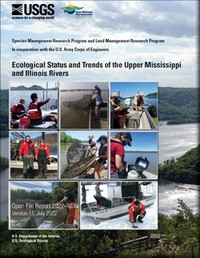
<p> Ecological status and trends of the Upper Mississippi and Illinois Rivers <p> <p> First posted June 22, 2022 <p> <p> Revised July 14, 2022 <p> For additional information, contact: Director, Upper Midwest Environmental Sciences Center U.S. Geological Survey 2630 Fanta Reed Road La Crosse, WI 54603 <p> Contact Pubs Warehouse <p> <p> Executive Summary <p> <p> This report assesses the status and trends of selected ecological health indicators of the Upper Mississippi River System (UMRS) based on the data collected and analyzed by the Long Term Resource Monitoring element of the Upper Mississippi River Restoration program, supplemented with data from other sources. This report has four objectives: providing a brief introduction of the UMRS, including its significance, history, modern-day stressors, and recent research; using ecological indicators to describe the status of the river system and where and how it has changed from circa 1993 to 2019; discussing management and restoration implications of these changes; and highlighting the fundamental role of long-term monitoring in the understanding, management, and restoration of large-floodplain rivers. <p> <p> The data were collected in the six Long Term Resource Monitoring element study reaches that spanned much of the UMRS and the various gradients contained therein. These study reaches included Navigation Pools 4, 8, 13, and 26; the part of the Unimpounded Reach of the Upper Mississippi River between Grand Tower and Cairo, Illinois; and the La Grange Pool on the Illinois River. The indicators included in this report describe the status and trends for the hydrology, geomorphology, floodplain vegetation, water quality, vegetation, and fishes of the UMRS. Many of the indicators of river ecosystem health changed significantly over the nearly 30 years of our evaluation. However, there was substantial spatial variability in the magnitude and timing of those changes among study reaches. Few indicators changed everywhere or nowhere; most indicators changed in some reaches but not others. The quantitative assessments of these indicators describe how the conditions of the river differ across hydrogeomorphic and climate gradients and through time and are intended to support the restoration and management of the UMRS. <p>